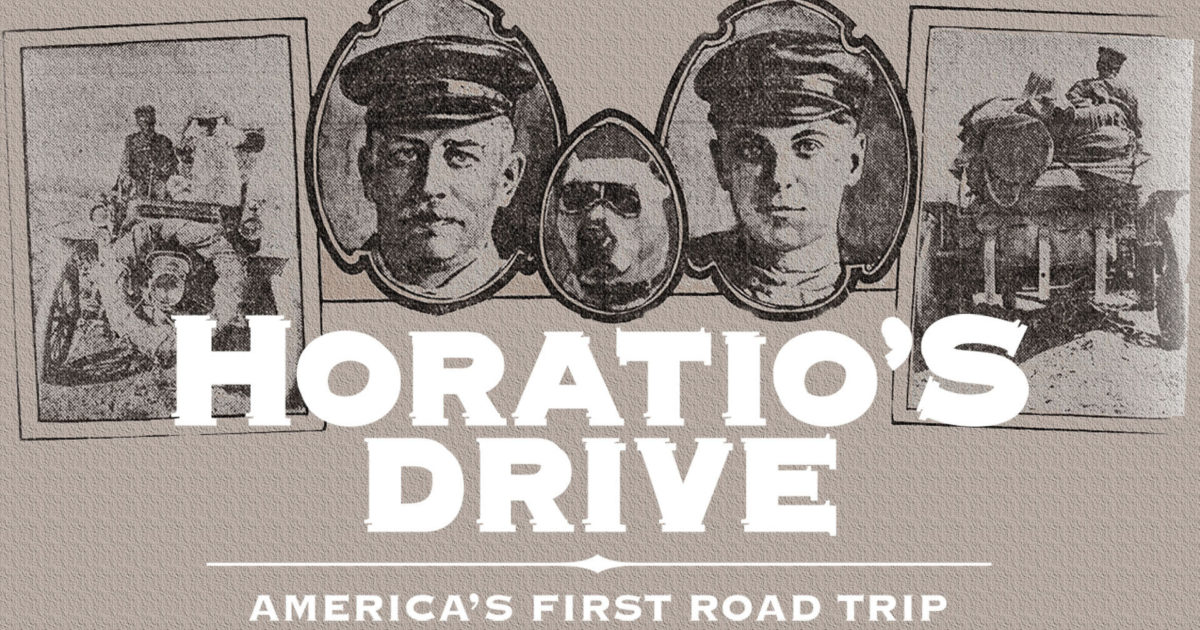
During our expeditions, we went up rocky mountain trails, forded any number of streams and creeks, drove through orchards and alkali flats, went careening down red rock canyons, and bumped along railroad tracks -- just like Horatio Nelson Jackson. We chased the massive terrifying storms that still patrol the prairies, just as we are sure Jackson tried to avoid or outrun them. We stood in awe in front of an old Pony Express way station that Jackson passed a century earlier, and one late afternoon in southwestern Wyoming we filmed along a dirt track that was at once a part of the Oregon, California, Pony Express and Mormon Trails.
Not far from that spot, we, like Jackson, got lost. We didn't go without food for thirty-six hours, as Jackson did, but after eating too big a meal at Cruel Jack's, a truck stop near Rock Springs, a few of us might have wanted to. Once, coming into Chicago, where three major interstates converge, we saw more cars in an hour's time than the number of cars that existed in America in 1903, the year Horatio made his impulsive trip.
We outfitted our wonderful cinematographer Allen Moore with a canvas harness and strapped him to the hood of our Chevy Suburban so that our filming would not just have the painterly style of our previous work, but the visceral, sometimes gut-wrenching perspective that Horatio and his companions surely had. (Later, we would "distress" this footage to give it just the right look we wanted, to give our viewers a sense of what it must have been like on the road back then.) In the Cascade Mountains of northern California, two Indians watched in amazement as we charged a mountain stream, Allen mounted on the front, just a few feet from a perfectly good bridge. Near Farson, Wyoming, a ranch hand watched Allen put his bra-like harness on for a drive near the historic South Pass, and then turned to his cowboy friend and said, "I'll be getting free drinks at the bar for a month for telling this story."
Along the route, we stopped at country museums, modest libraries and proud historical societies in many of the small towns Jackson had passed through and found even more great photos: some of Horatio we never knew existed, and some of town life at the turn of the twentieth century that helped us immeasurably in conjuring up that earlier era and the excitement townspeople obviously felt at his arrival. Newspaper morgues in those same small towns added many colorful local accounts of the trip we weren't aware of.
Through it all, we could not help but drink up the powerful tonic, the powerful medicine, which moving across this extraordinary country always is. It sustained and inspired and overwhelmed us. We felt often as if we were moving through time as well as through the landscape, and came to understand, as no armchair surveyor ever can, the immense size and almost stupefying distance that is the American West, both today and yesterday, when Horatio Nelson Jackson made his bold, and now to us almost unbelievable, run.
In an interview for our film on Mark Twain, the novelist Russell Banks said that despite our common "threads of history" with Europe, we Americans have had to write our own epics, our own Iliads and Odysseys, that illuminate the differences between us and our European forebears. And the elements, he said, "that make us different are essentially two: race and space." As filmmakers who have been interested in learning ever more about the mechanics of our complicated and often dysfunctional Republic, we have returned again and again to the question of race in many of our films, trying to come to terms with the monumental hypocrisy born at our inception when our founders attempted to reconcile chattel slavery in a new nation that had just proclaimed the universal rights of all men.
But we have also been equally drawn over the years to the power and magnetism of the American landscape, this huge space of ours, and its central role in the formation of a distinct American sensibility and character. It, too, has figured in some way in nearly every film we have made. Sometimes, as in The West, Lewis and Clark and Mark Twain, Banks' twin themes intertwine and co-mingle in almost equal and obvious measure. (In other films, these themes are somewhat distinct, though the fact that race may have been dominant in The Civil War, Baseball and Jazz did not mean that the question of space wasn't always close by, continually influencing the American narrative we sought to explore.)
In Horatio's Drive, we have tried to paint a seemingly simpler story, one of history from the bottom up, not top down, but one that gets its energy from the sheer physicality of these United States and the extraordinary human beings who have inhabited that space. The virtues and qualities and strengths that we hope radiate out from this story are seemingly simpler, too, though, as my friend Dayton Duncan knows in his gut, the medicinal force of a great road trip, like the horseless carriage or this still wild American landscape itself, cannot be pooh-poohed.
Maybe, William Least Heat-Moon, author of the magnificent "Blue Highways" and a commentator in this film, put it best:
"There's nothing that we can do that is more American than getting in a car and striking out across country. I think as a nation we can think of few things that draws us more strongly than a piece of roadway heading we know not where. This is the way we grow up, this is the way we enter our history: get in a car and find the country."
And ourselves.
Ken Burns
Walpole, New Hampshire
Excerpted from Horatio's Drive: America's First Road Trip by Dayton Duncan and Ken Burns, a Borzoi Book published by Alfred A. Knopf. Copyright © 2003 by The American Lives II Film Project, LLC. All rights reserved.
ncG1vNJzZmivp6x7sa7SZ6arn1%2Bgsq%2Bu1KulrGeYpL%2BiwMioqmacop7DpnvNqKueZZanvK55yp6lZpqlp7u0